

Understanding the ACR TIRADS System for Ultrasound of Thyroid Nodules

Updated: 23 hours ago
Thyroid nodules are common, and many people face uncertainty when they discover one. The key question is whether a nodule is benign or requires further investigation. The American College of Radiology Thyroid Imaging Reporting and Data System (ACR TIRADS) helps doctors evaluate thyroid nodules using ultrasound images. This system guides decisions about which nodules need biopsy or follow-up, making the process clearer and less stressful for patients.
Dr John Chaplin has extensive experience using office ultrasound and ultrasound-guided fine needle aspiration (FNA) to assess thyroid nodules. His hands-on approach helps patients get accurate diagnoses quickly and comfortably. This post explains the ACR TIRADS system in simple terms and shares how Dr Chaplin’s expertise benefits patients.
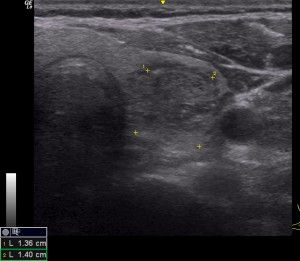
Close-up view of thyroid ultrasound image showing a thyroid nodule
What is the ACR TIRADS System?
The ACR TIRADS system is a standardized way to classify thyroid nodules surgeries which based on ultrasound features. It assigns points to specific characteristics of a nodule, such as its shape, composition, and appearance. The total points place the nodule into one of five categories, which indicate the risk of cancer and suggest the next steps.
How the ACR TI-RADS Score Works?
Doctors look at five features on the ultrasound:
Composition: Is the nodule solid, cystic (fluid-filled), or mixed?
Echogenicity: How bright or dark is the nodule compared to normal thyroid tissue?
Shape: Is the nodule taller than it is wide?
Margin: Are the edges smooth or irregular?
Echogenic foci: Are there tiny bright spots inside the nodule, which can suggest calcifications?
Each feature scores points from 0 to 3. The points add up to a total score that fits into one of these categories:
TR1 (0 points): Benign, no follow-up needed
TR2 (2 points): Not suspicious, routine follow-up
TR3 (3 points): Mildly suspicious, consider follow-up or biopsy depending on size
TR4 (4-6 points): Moderately suspicious, biopsy recommended if nodule is large enough
TR5 (7+ points): Highly suspicious, biopsy usually recommended
This scoring helps doctors decide which nodules need biopsy and which can be safely monitored.
Why ACR TIRADS Matters for Patients
Before ACR TIRADS, doctors used different criteria, which sometimes led to unnecessary biopsies or missed cancers. This system improves consistency and reduces unnecessary procedures. Patients benefit by avoiding anxiety and invasive tests when not needed.
For example, a small cystic nodule with smooth edges and no suspicious features might be classified as TR2, meaning it can be safely watched over time. On the other hand, a solid nodule with irregular margins and microcalcifications might be TR5, prompting a biopsy to rule out cancer.
Dr John Chaplin’s Role in Thyroid Nodule Assessment
Dr John Chaplin has decades of experience performing office ultrasounds and ultrasound-guided fine needle aspiration (FNA) biopsies. His approach combines the ACR TIRADS system with real-time imaging to provide accurate, minimally invasive diagnosis.
Office Ultrasound
Dr Chaplin uses ultrasound in his office to examine thyroid nodule assessment during the patient visit. This immediate imaging allows him to:
Assess nodule features using ACR TIRADS criteria
Explain findings clearly to patients with visual aids
Decide on the need for biopsy without delay
Ultrasound-Guided FNA
If a biopsy is needed, Dr Chaplin performs ultrasound-guided FNA. This technique uses ultrasound to guide a thin needle precisely into the nodule, collecting cells for analysis. Benefits include:
High accuracy in sampling suspicious areas
Minimal discomfort and quick procedure
Faster diagnosis compared to referrals to other centers
Patients appreciate Dr Chaplin’s skill and the convenience of having diagnosis and biopsy in one place.
Understanding Your Ultrasound Report with ACR TIRADS
When you get an ultrasound report, it may include a TIRADS category. Here’s what to expect:
TR1 or TR2: Your nodule is benign or low risk. Usually, no biopsy is needed. Your doctor might suggest routine check-ups.
TR3: Mildly suspicious nodules might need biopsy if they are larger than 2.5 cm or close monitoring if smaller.
TR4: Moderately suspicious nodules often require biopsy if larger than 1.5 cm.
TR5: Highly suspicious nodules usually need biopsy if larger than 1 cm.
Size thresholds vary slightly depending on guidelines, but ACR TIRADS helps make these decisions clearer.
What Patients Should Know About Thyroid Nodules
Most thyroid nodules are benign and do not cause symptoms.
Ultrasound is the best tool to evaluate nodules without radiation.
The ACR TIRADS system helps avoid unnecessary biopsies.
If biopsy is needed, ultrasound-guided FNA is safe and accurate.
Regular follow-up is important to monitor any changes.
Dr Chaplin’s experience means patients get personalized care with clear explanations and timely procedures.
Final Thoughts
Understanding the ACR TIRADS system empowers patients to make informed decisions about thyroid nodules. It simplifies complex ultrasound findings into clear categories that guide care. Dr John Chaplin’s expertise in office ultrasound and ultrasound-guided FNA ensures patients receive accurate diagnosis and treatment with minimal stress.
If you have a thyroid nodule, ask your doctor about ACR TIRADS and whether ultrasound-guided biopsy is appropriate. Early and clear assessment helps avoid unnecessary procedures and supports your health with confidence.
Frequently Asked Questions
What is ACR TIRADS for thyroid nodules?
ACR TIRADS is an ultrasound-based scoring system used to classify thyroid nodules by their features and estimate how suspicious they are for cancer. It helps guide decisions about follow-up and whether a fine needle aspiration (FNA) biopsy is needed.
What is an ACR TIRADS 3 thyroid nodule?
An ACR TIRADS 3 (TR3) thyroid nodule is classified as mildly suspicious based on its ultrasound features. Depending on its size, it may require follow-up ultrasound or, for larger nodules, FNA biopsy.
What percentage of TR4 thyroid nodules are cancerous?
The estimated risk of malignancy for ACR TIRADS 4 nodules is generally around 5–20%, depending on the specific ultrasound features and the scoring system used. A TR4 classification does not mean that the nodule is cancerous.
What size thyroid nodule should be biopsied?
The size at which a thyroid nodule should undergo FNA depends on its ACR TIRADS category. Under ACR TIRADS, FNA is generally considered at ≥2.5 cm for TR3, ≥1.5 cm for TR4, and ≥1 cm for TR5 nodules.
How accurate is TIRADS in detecting thyroid cancer?
TIRADS is a useful ultrasound-based system for estimating the risk that a thyroid nodule is cancerous, but it cannot diagnose cancer on its own. Higher categories such as TR4 and TR5 indicate greater suspicion and may lead to an ultrasound-guided FNA biopsy for confirmation.

Comments